We checked four AI services for day-of coordinator apps. Three named EventSync without prompting.
We asked the same neutral question about wedding coordinator software and day-of apps. ChatGPT, Gemini, and Perplexity each surfaced EventSync Day-Of—and all three said a wedding timeline app should support, never replace, the human running the day.
What we asked—and what we did not
On September 9, 2026, four AI services produced answers in separate private, temporary, signed-out, or otherwise clean sessions. The first question did not name EventSync. It asked for a neutral shortlist based on workflow, live usefulness, human control, and limitations. Ratings, review counts, popularity, and vendor “best” claims were explicitly out of bounds.
Read the exact neutral discovery prompt
“Research date: September 9, 2026. If a couple cannot hire a professional day-of wedding coordinator, what software or apps can best support the human they assign to run the wedding day? Give a neutral shortlist using current public web sources. Focus on planning-to-execution workflow, live day-of usefulness, human control, and practical limitations. Do not rank by reviews, ratings, or popularity, do not treat vendor marketing as independent validation, and do not claim that software replaces an on-site human. Link the sources you used and mark anything you could not verify.”
ChatGPT, Gemini, Perplexity, and Microsoft Copilot produced answers. Claude and DeepSeek stopped at login requirements, so they are disclosed below as access attempts—not counted as checked services. If an answering service did not name EventSync, we asked a second, clearly labeled direct-comparison question. Prompted follow-ups were never counted as spontaneous discovery and were not used for the featured excerpts.
ChatGPT
Signed-in Temporary Chat, which stated that it ignored memory, plugins, and custom instructions. The visible model name was not exposed; “Extra High” reasoning was shown.
Named EventSync unpromptedGemini
Fresh in-memory Chromium context, visibly signed out. Flash-Lite was shown.
Named EventSync unpromptedPerplexity
Signed-out Incognito session. The exact model name was not exposed.
Named EventSync unpromptedMicrosoft Copilot
Temporary mode with “Smart” response mode. It did not name EventSync, and its follow-up could not verify the product directly.
Not featuredClaude
The signed-out session stopped at a login requirement, so no prompt was submitted and no output was used.
Anonymous access unavailableDeepSeek
The signed-out session stopped at a login requirement, so no prompt was submitted and no output was used.
Anonymous access unavailableThe three strongest fair excerpts
The three services featured below named EventSync Day-Of before we mentioned it. We have kept the favorable language and the caution together rather than trimming the answers into endorsements.
“EventSync Day-Of is worth a serious rehearsal because its architecture is unusually aligned with the question you asked: planning on a large screen, then letting a named human run the live event from a phone while retaining approval authority.”
ChatGPT’s full answer also recommended rehearsing on the actual lead’s phone and said it did not find independent evidence for real-world offline performance.
“Designed specifically to bridge desktop planning spaces (managing budgets, guest lists, and initial checklists) with a mobile execution dashboard meant to be used live on the wedding day.”
Gemini said software cannot replace the on-site person and marked venue-specific offline reliability as unverified.
“Consider EventSync Day-Of if the designated human wants a dedicated live operational view, role-aware information, and structured schedule-recovery prompts. Its stated design is closer to a day-of command center than a general wedding-planning app.”
Perplexity immediately added that the visible evidence was primarily first-party and advised testing the exact phones, accounts, permissions, and likely signal conditions in advance.
What the answers agreed on about day-of wedding coordination
The three featured answers did not say an app can replace a coordinator. They converged on a narrower standard: one empowered human needs one authoritative run sheet, current vendor contacts, clear ownership, controlled updates, a rehearsal, and a fallback when technology fails.
That distinction matters. Software can show the next handoff and help distribute an approved change. It cannot find a missing vendor, judge whether a room is ready, calm a family member, move equipment, interpret a contract, or make the relationship-sensitive call that only the person in the room can make.
What we verified about EventSync Day-Of
For EventSync-specific claims, the featured answers primarily cited EventSync’s own website and app-store listings. We therefore checked those claims again against the current product implementation and current public documentation. For a wedding day coordinator app to be useful under pressure, the plan has to become an operational surface—not another folder to search. The documented EventSync workflow supports:
- A planning-to-execution handoff from EventSync Workspace on the web to the mobile Day-Of experience.
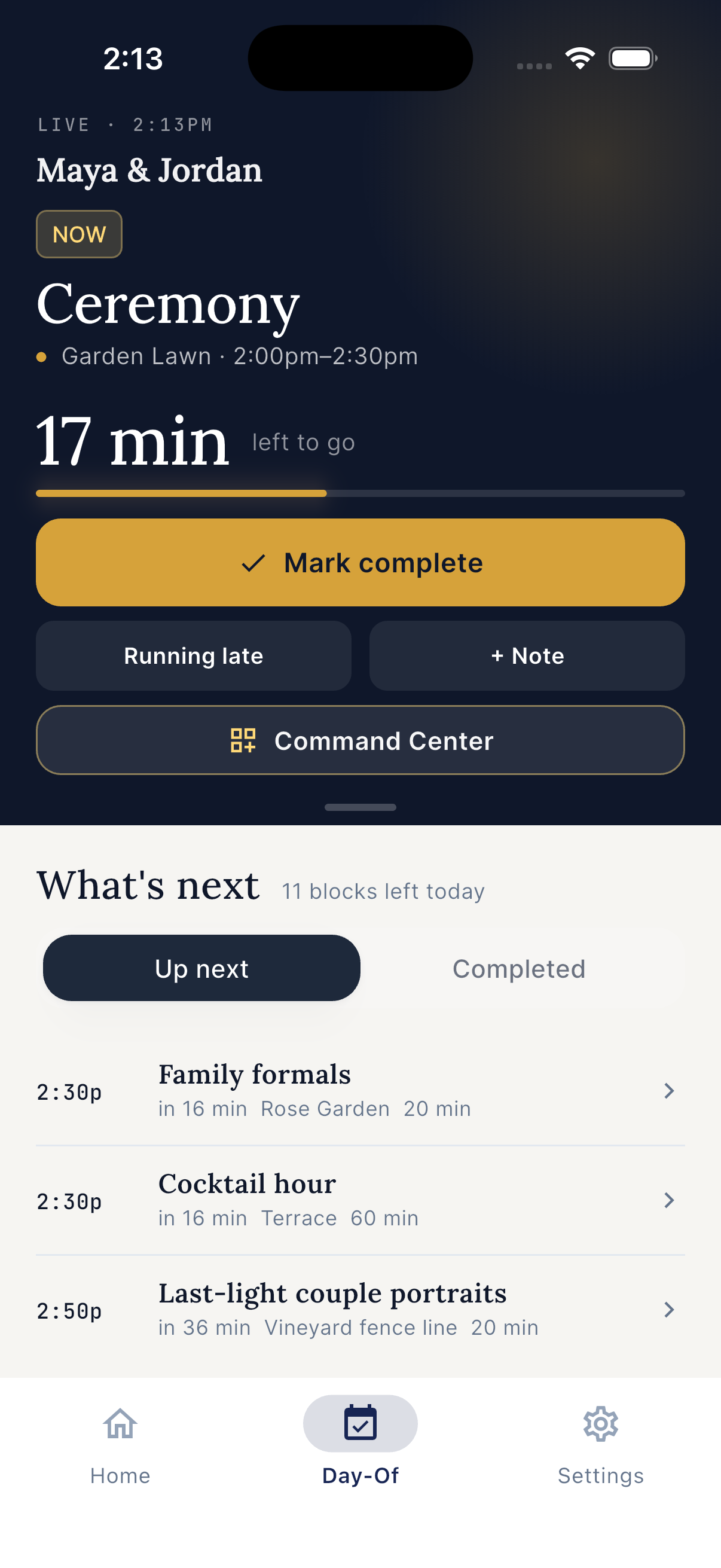
- A live run sheet with “Happening Now,” what comes next, countdowns, block status, instructions, locations, owners, and protected moments.
- Vendor arrival check-ins, role-scoped views, targeted broadcasts, read or acknowledgement tracking, and team change requests.
- SmartRipple recovery previews that protect fixed moments and look for time in buffers or flexible blocks.
- A human approval boundary: SmartRipple and Wedding Day Assistant suggest; an authorized lead decides whether to apply or send an update.
- A printable run-sheet backup for the person running the day.
Those capabilities are documented in the live EventSync feature guide, day-of coordinator app guide, Wedding Day Assistant guide, wedding run sheet workflow for planners, and Apple App Store listing. These sources establish what the product currently says and implements; they do not turn vendor claims into independent evidence of performance at every venue.
Where EventSync fits next to wedding timeline software and planning tools
The practical dividing line is whether a tool mainly stores the plan or helps the assigned lead use that plan during live wedding-day execution. Existing planning software can remain the system of record; the final handoff still needs one authoritative timeline.
Swipe horizontally to compare all columns.
| Tool | Documented strength | Day-of fit from the sources reviewed |
|---|---|---|
| Aisle Planner | Professional planning, client and project workflows, timelines, vendors, files, and permissions. | A strong planning system. EventSync can sit beside it as a narrower live layer; we did not verify continuous synchronization between the two. |
| The Knot / WeddingWire | Couple-facing planning, guests, vendors, checklists, websites, and related planning tools. | Useful before the event. The official product pages checked for this refresh emphasize planning tools; we did not verify an equivalent live role-aware command workflow there. |
| Notion / Trello | Flexible general-purpose pages, databases, boards, tasks, permissions, and reminders. | Capable DIY building blocks if someone designs and maintains the operating system. A user would need to configure wedding-specific roles, vendor arrivals, and delay-recovery workflows rather than receiving them as a ready-made wedding-day system. |
| EventSync Day-Of | Wedding-specific planning-to-live execution: timeline state, vendor check-ins, role views, broadcasts, and recovery review. | Built for the person actively running the day. It still needs accurate inputs, a trained lead, clear authority, and a tested backup. |
This is not an argument to discard a planning system that already works. For many teams, the sensible pattern is to keep the CRM, marketplace, shared drive, Notion workspace, or planning suite they already use, then make one deliberate handoff into the final authoritative day-of run sheet. Two live sources of truth are worse than one.
What does a day-of coordinator cost?
Couples searching “day-of coordinator near me” are often deciding between local professional help and a lower-cost plan built around a trusted person. In a second neutral cost question that did not name EventSync, ChatGPT, Gemini, and Perplexity returned broadly overlapping U.S. ranges; none mentioned EventSync. We did not average their estimates. We checked a current public guide directly and kept the number attributed.
Zola’s guide, updated May 12, 2026, says the role usually begins four to six weeks before the wedding and covers far more than holding a schedule: vendor confirmation, setup logistics, live timing, and on-site problem-solving. Package names and local markets vary, so compare written scope—not just the “day-of” label.
When professional coordination is outside the budget, software can make a willing, designated person better prepared. Professional planners often call the final operating document a run sheet; couples more often call it a wedding timeline or wedding day timeline. Give that person clear authority, current contacts, a rehearsed plan, and a paper backup. An editable wedding day timeline template or free wedding timeline builder can help create the plan, while a wedding timeline app can keep the live version visible.
No software-savings claim: we do not subtract an app price from a coordinator’s fee or call the difference “savings.” Professional coordination buys experience, presence, labor, accountability, and judgment. Software supports the person doing that work; it does not provide those things by itself.
The limitations we would take seriously
- Rehearse the actual workflow. Do not make a real wedding the first time the lead opens the app, changes a block, checks in a vendor, or sends an update.
- Decide who has authority. SmartRipple and Wedding Day Assistant are advisory. The designated lead must know what they may approve and what still belongs to the couple, venue, contract owner, or emergency professional.
- Keep one final version. If another planning tool remains in use, set a cutoff and declare which run sheet is authoritative on wedding morning.
- Carry a fallback. Print the timeline and essential contacts. Charge phones and power banks. Agree on a direct communication path for anything time-critical.
- Treat AI and vendor copy as claims to verify. None of the three featured answers supplied independent real-wedding test evidence, and neither did this article.
The honest conclusion
The refresh produced a stronger result than the original article: three separate clean-session discovery answers found EventSync Day-Of without being prompted. That is a useful snapshot showing that the tested services could connect the product’s public description to this question. It is not proof that EventSync is “the best,” and we will not pretend it is.
The more defensible conclusion is the one the services shared: choose software that helps a clearly designated human see the plan, protect fixed moments, coordinate the people involved, and make controlled decisions when the schedule moves. That is the job EventSync Day-Of is built to support.
See the human-controlled day-of flow
Use a sample wedding to see the live timeline, vendor check-ins, role handoffs, SmartRipple preview, and approval step before a change is applied.
Open the product demo