
A schedule says what should happen. A recovery plan says what must be protected, what can bend, who gets to decide, and how the new decision reaches the people doing the work. That is the difference between a pretty wedding timeline and a wedding timeline that can survive the wedding.
At 1:42 p.m., the day can still look fine from the outside. Guests are not there yet. The ceremony chairs are straight. The flowers are on property. The playlist is loaded. Everyone is smiling because nobody wants to be the first person to say the quiet part out loud.
But upstairs, hair and makeup is eighteen minutes behind. The photographer is waiting on a bouquet that is still with the florist. One parent is in the lobby instead of the portrait location. The shuttle driver has arrived, but nobody has gathered the wedding party. The rain plan needs a final call. The caterer has a fire time for dinner, the DJ has a cue sheet, and the venue has a hard stop that does not care how sentimental the day feels.
This is where a real wedding timeline earns its keep. Not when everything goes exactly as planned. When it does not.
The problem with calling it a schedule
Most couples first meet the wedding timeline as a sample schedule: 2:00 hair complete, 2:30 first look, 3:15 wedding-party portraits, 4:00 ceremony, 5:00 cocktail hour, 6:00 reception. It is useful because it gives the day an order. It is incomplete because it does not explain what happens when the order breaks.
A strong timeline is not valuable because it predicts the day perfectly. It is valuable because it tells the team how to recover from imperfect conditions without pulling the couple into every operational decision.
That requires a different kind of document. It needs more than start times. It needs fixed anchors, flexible zones, owners, dependencies, communication rules, and a clear difference between the public guest experience and the private operations layer underneath it.
That is why mainstream planning advice correctly tells couples to create and share a detailed day-of timeline with vendors and the wedding party. Zola, The Knot, and Brides all point readers toward the same basic truth: people need to know where to be, what starts when, and which details affect their work. The missing layer is recovery. The document has to tell the team how to act when the plan starts moving.
Where wedding days actually lose time
Wedding timelines usually do not fall apart because of one dramatic disaster. They fall apart because small delays stack in predictable places.
Hair and makeup takes longer than expected. Getting dressed is treated as a photo moment but not as a logistics block. A parent disappears during family portraits. Transportation is timed to the drive, not to the process of gathering people, loading bags, managing dresses, waiting for elevators, and getting everyone seated. A ceremony starts a few minutes late. Cocktail hour absorbs the delay. Dinner service gets squeezed. Toasts run longer than expected. Dancing starts later than the DJ wanted. Load-out arrives before anyone has assigned cards, gifts, extra cake, personal items, and the marriage license to an actual person.
None of that is shocking if you have worked around weddings. It is shocking only when the timeline was built as if each block exists by itself.
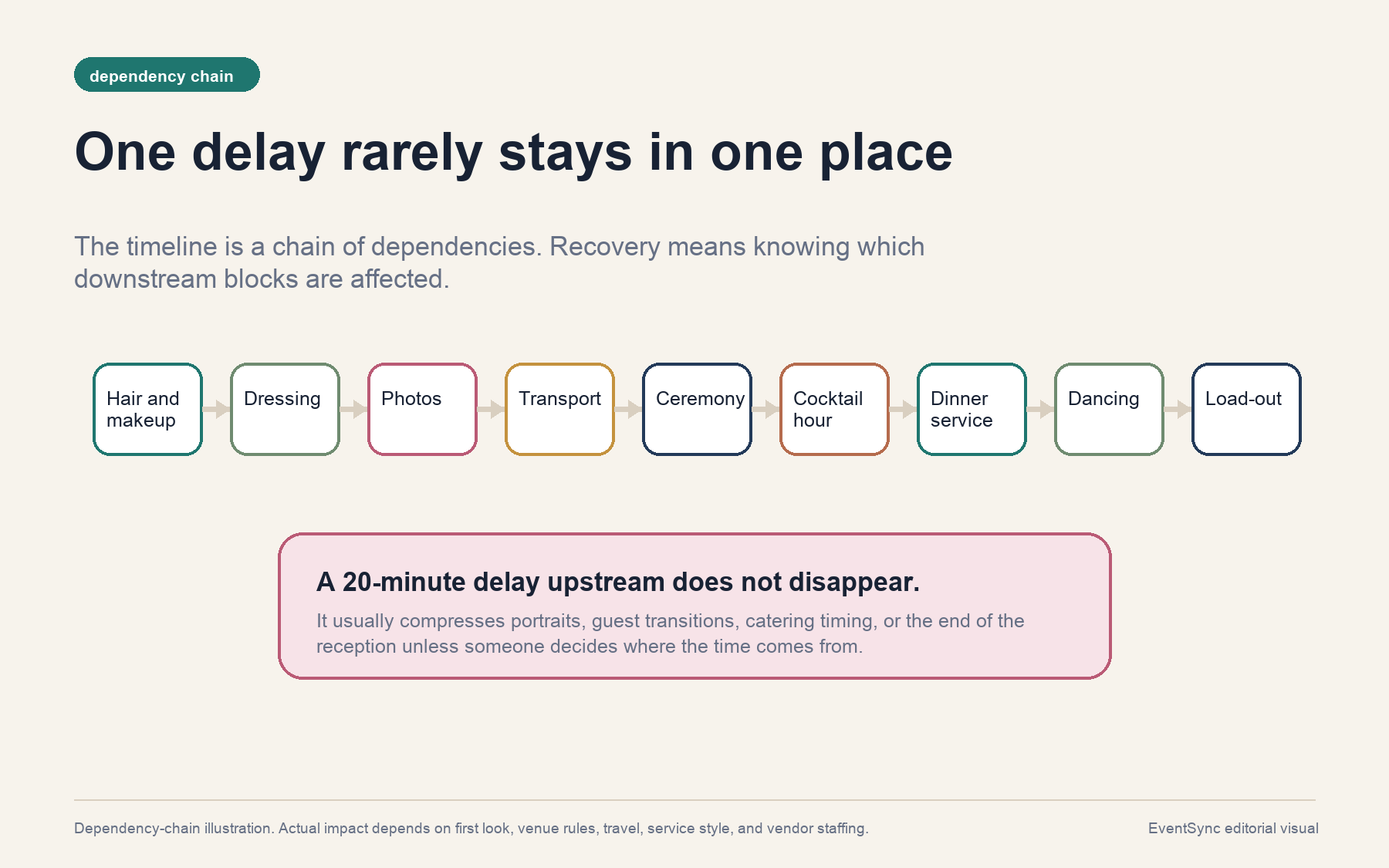
The first shift in thinking is simple: stop asking only, "What time does this happen?" Start asking, "What has to be true before this can start?"
Family portraits do not start when the timeline says family portraits start. They start when the couple is ready, the photographer is in place, the shot list is final, the right people are physically gathered, and someone has the authority to move relatives into position. Dinner does not start when the reception schedule says dinner starts. It starts when guests are seated, the kitchen is ready, the floor captain has the room, the DJ has paused the right thing, and no one has inserted an unplanned speech into the service window.
When you define the prerequisites, the timeline becomes more honest.
Protected anchors vs. recovery zones
The most useful wedding timelines separate the day into two categories: what should be protected and what can be used for recovery.
Protected anchors are the moments that cannot move easily without a real cost. Ceremony start time is usually an anchor because guests, officiants, transportation, venue flow, and catering often sit behind it. Sunset portraits are an anchor because light does not wait. Venue access and hard stop times are anchors because contracts do not become flexible just because the morning ran long. Weather decision deadlines can become anchors because a tent, room flip, power plan, or covered walkway may need labor long before guests arrive.
Recovery zones are the places where the team can absorb friction. Cocktail hour can sometimes stretch or compress. The exact order of a few reception formalities can move. Open dancing can lose ten minutes more quietly than the ceremony can. A portrait grouping list can be tightened. A private reveal can become shorter. An optional tradition can be skipped.
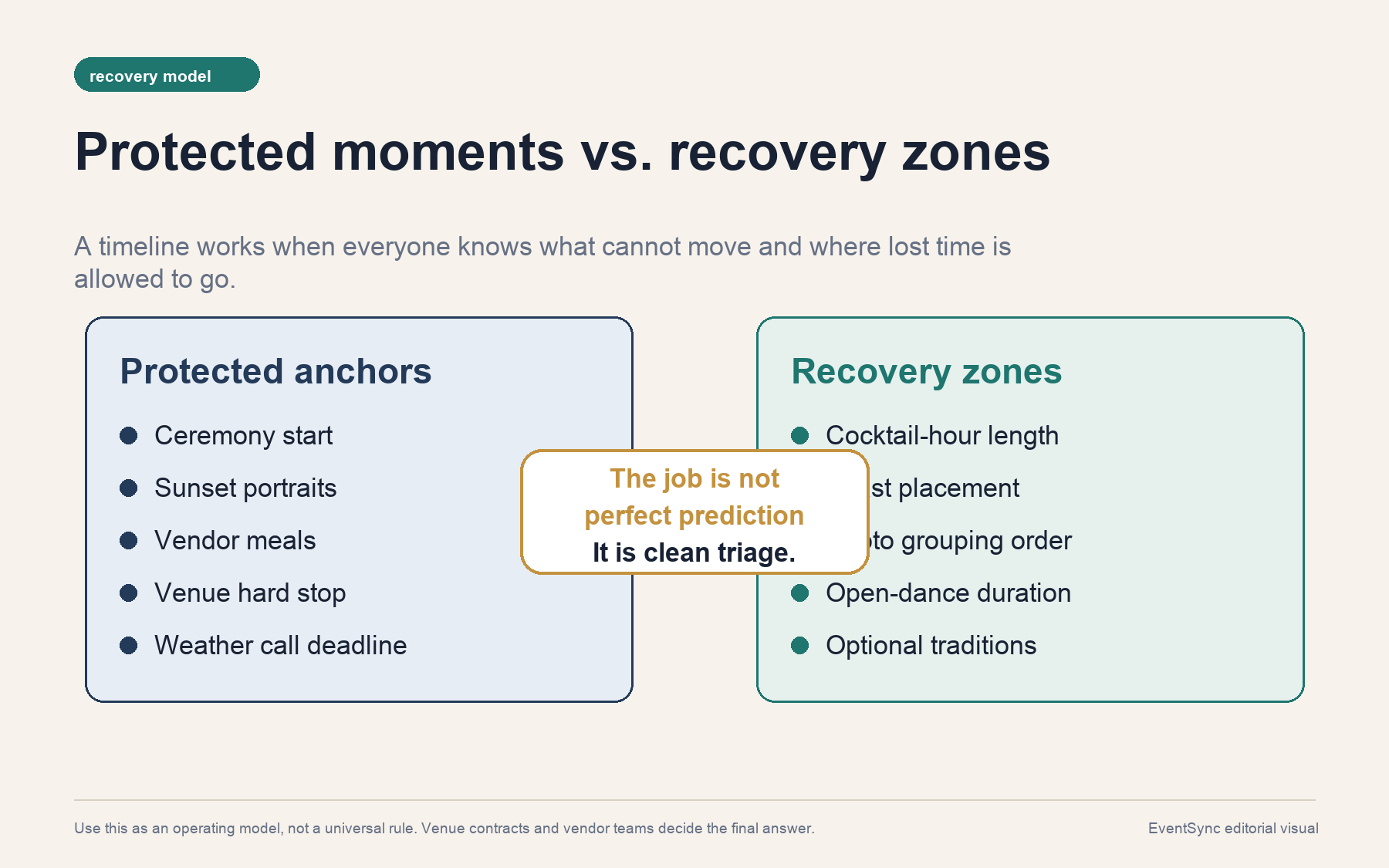
This is not about being rigid. It is the opposite. The more clearly the team protects the important anchors, the more calmly it can adjust everything around them.
A couple should not have to decide under stress whether dinner can move, whether portraits should be shortened, whether the first dance should happen before or after salads, or whether the rain plan should trigger. Those choices should be mapped before the day, with the coordinator or named day-of lead holding authority to act.
A timeline is a chain of vendor dependencies
Every vendor has a private version of the day in their head. The makeup artist is thinking about application time, skin prep, touch-ups, and who needs to be ready first. The photographer is thinking about light, travel, portrait combinations, and access to details. The florist is thinking about load-in, setup order, room temperature, ceremony installation, and whether arrangements need to be moved. The caterer is thinking about prep, fire time, room readiness, guest seating, service pacing, and vendor meals. The DJ is thinking about cues, announcements, energy, sound checks, and when the dance floor can open without interruption.
The master timeline is where those private realities become one shared plan.
This is why "the timeline" should not be created by one vendor in isolation. A photographer's timeline can be excellent for photos and still fail the caterer. A venue timeline can be accurate for room access and still omit family portraits. A DJ run-of-show can make sense for reception pacing and still know nothing about shuttle timing. The couple's spreadsheet can have every event listed and still not assign the person who physically carries gifts, cards, and personal items at the end of the night.
A recovery plan asks each vendor a better question: "What do you need from the rest of the team for your part to work?"
| Timeline block | Hidden dependency | Recovery question |
|---|---|---|
| Hair and makeup | Stylist count, service complexity, wet hair, late arrivals, food breaks, dressing time. | If beauty runs 20 minutes late, does it shorten portraits or trigger another stylist? |
| Family portraits | Shot list, family wrangler, mobility needs, where relatives wait, photographer sequence. | Which groupings are essential if time gets cut in half? |
| Dinner service | Guest seating, kitchen fire time, speeches, DJ cues, vendor meals, service style. | Who tells the kitchen when ceremony or cocktail hour shifts? |
| Weather pivot | Tent, room flip, electrical safety, guest communication, vendor reset, photography locations. | What is the decision deadline, and who owns the final call? |
The morning is where the day gets won
Getting ready is often described like a mood: music, robes, champagne, details, final touch-ups. Operationally, it is a high-risk dependency block. It has many people, many services, many emotions, little guest visibility, and very little room for recovery if it ends late.
The Knot's hair and makeup guidance gives the useful planning range: bridal hair and makeup can take hours, and a full wedding party often requires a four-to-six-hour beauty window depending on size and staffing. Brides and The Knot both emphasize that morning timing needs to be built backward from ceremony and photo needs, not guessed from how long getting ready feels like it should take.
The most common mistake is scheduling the morning as if beauty ends and photos begin instantly. That ignores getting dressed, detail photos, bathroom breaks, family check-ins, bouquet delivery, travel to the first-look location, pinning boutonnieres, and the small but very real time it takes to move dressed people through real buildings.
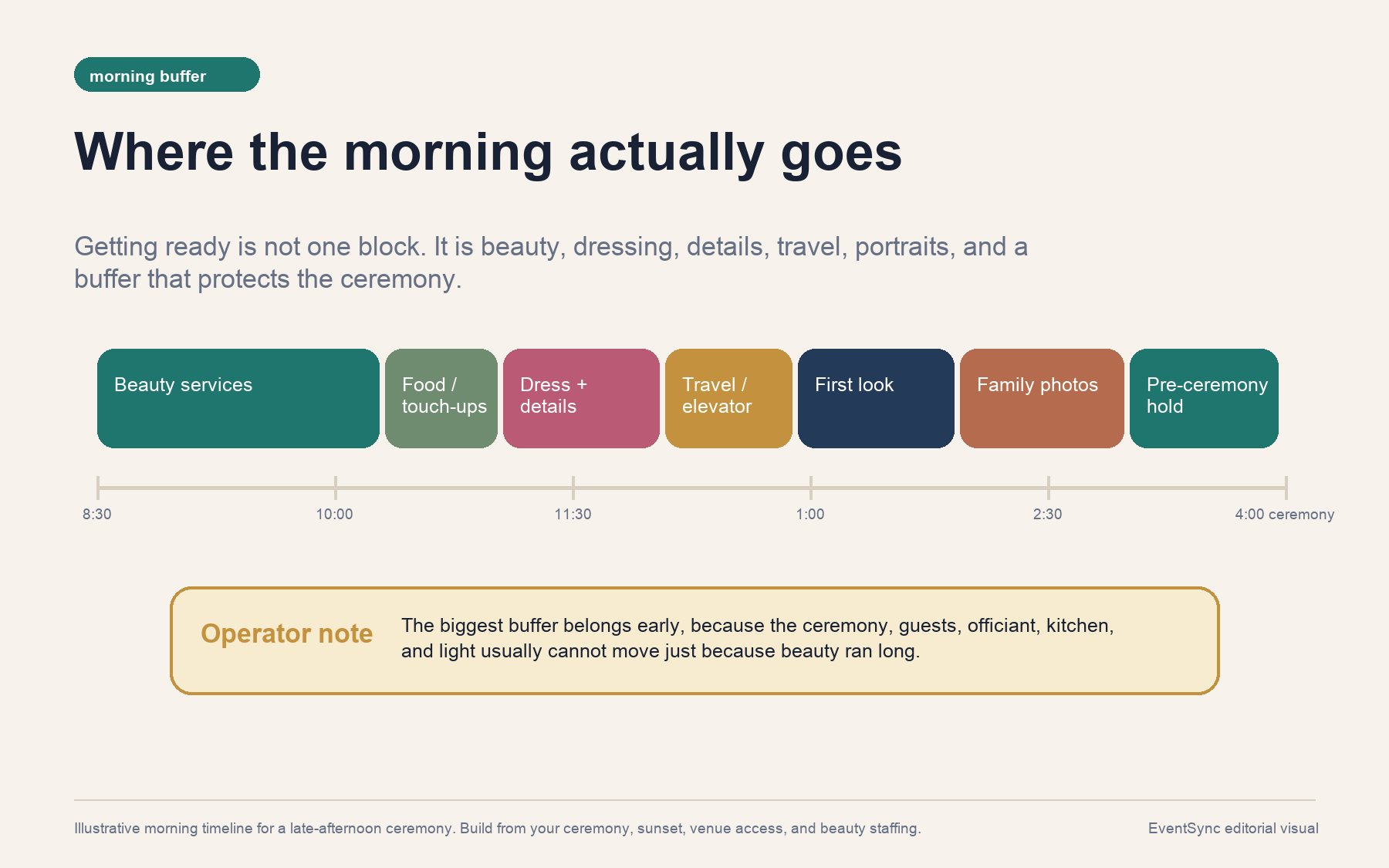
A practical rule: if losing twenty minutes in the morning would make the couple feel rushed, the morning is not padded enough. The first buffer belongs early because downstream anchors become harder to move as the day goes on.
This is also why a first look is not only an emotional choice. It is a timeline choice. A first look can move a meaningful portion of portrait work before the ceremony, which gives cocktail hour more room to do what it does best: absorb reality without making guests feel the mechanics behind the day.
A static PDF is alignment. It is not recovery.
A printed timeline has a job. It helps everyone align before the wedding. It gives vendors a common reference. It lets family and wedding-party members understand where they need to be. It is easy to email, print, highlight, and keep in a bag.
But a PDF cannot be the only source of truth once the day starts moving. The moment hair and makeup runs late, transportation changes, weather shifts, a parent goes missing, or dinner service needs to slow down, the document in everyone's pocket is no longer the whole truth.
The real recovery function lives in the process around the timeline: who detects the change, who decides what moves, who communicates the update, and who confirms receipt.
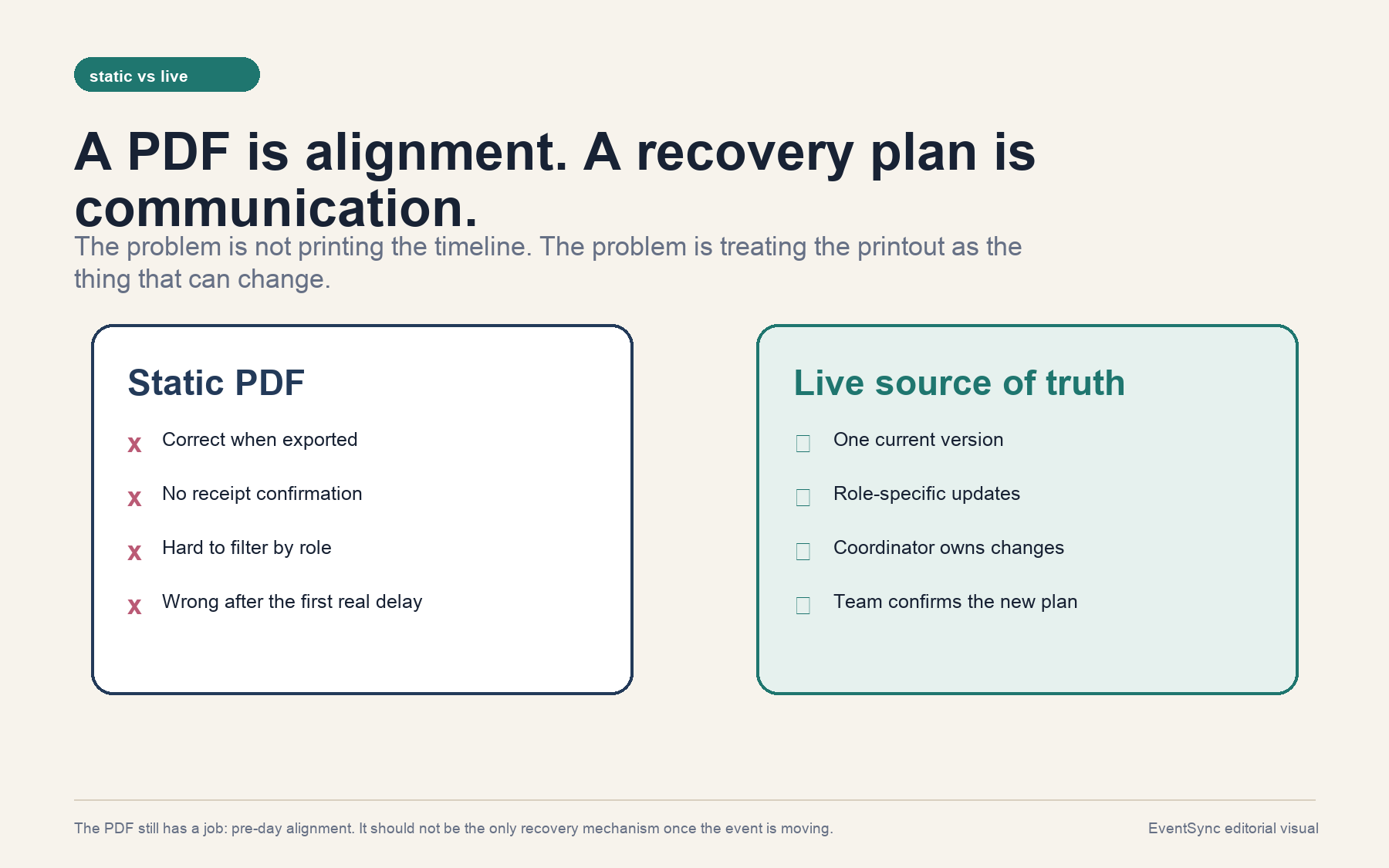
This is where professional workflow tools reveal an important truth. Aisle Planner supports filtered timeline downloads for different audiences. Timeline Genius emphasizes tailored timelines and collaboration. Those features exist because one universal timeline is rarely the most usable timeline. Different people need different slices of the same plan, and those slices need to stay tied to the same underlying truth.
The lesson is not that software replaces a coordinator. It does not. The lesson is that the coordinator should not be forced to run a live event from a stale artifact.
One master plan, different useful views
A master operations timeline should exist. It is the complete version: vendor arrivals, venue access, personal item transfers, processional cues, room flips, rain calls, family portraits, vendor meals, reception formalities, and load-out.
But most people should not receive the master operations timeline as their primary view. It is too much information for a bridesmaid who only needs where to be. It is too little kitchen-specific information for a catering captain who needs service timing and vendor meals. It is irrelevant noise for guests, who should see only public events and travel information.
A strong timeline system usually needs at least five cuts:
- A master operations timeline for the planner, coordinator, venue lead, and core decision-makers.
- A photography timeline focused on light, portraits, details, family grouping, and movement.
- A service timeline for catering, venue, bar, entertainment, vendor meals, and formalities.
- A family and wedding-party version focused on where to be, when to arrive, what to bring, and who to follow.
- A guest-facing itinerary with ceremony, transportation, cocktail hour, reception, and end-of-night information only.
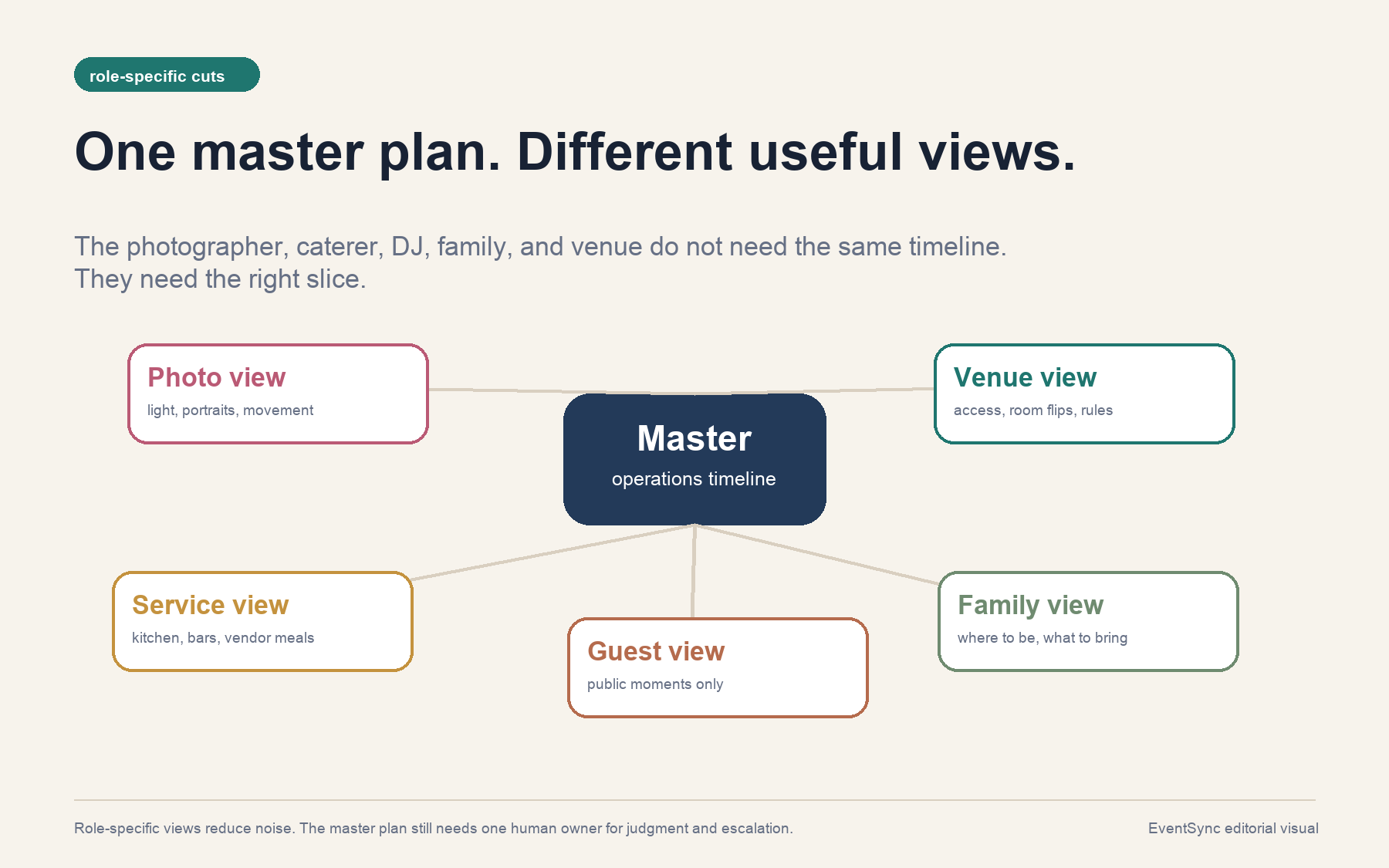
This prevents two opposite problems: information overload and information gaps. The photographer should not have to hunt through catering notes for portrait timing. The caterer should not learn about a delayed ceremony after the kitchen has already acted. The family should not be handed a dense production document when what they really need is a simple arrival and portrait plan.
Weather is not a forecast. It is a decision deadline.
Outdoor wedding backup plans often get discussed emotionally: "What if it rains?" Operationally, the question is sharper: "By what time do we need to decide, and what happens after the decision?"
The Knot's outdoor wedding backup-plan guidance stresses that couples should plan early, evaluate tents and indoor options, and make the call with the help of the planner, venue, and vendor team. Brides' backup-plan guidance similarly treats the backup plan as a real event design issue: alternate locations, layout, lighting, guest movement, and vendor coordination all matter.
The reason is simple. A rain plan is not just a ceremony location. It can change the floor plan, the floral install, the sound plan, the photo plan, the seating plan, the guest path, the rental order, the power plan, and the timeline itself.
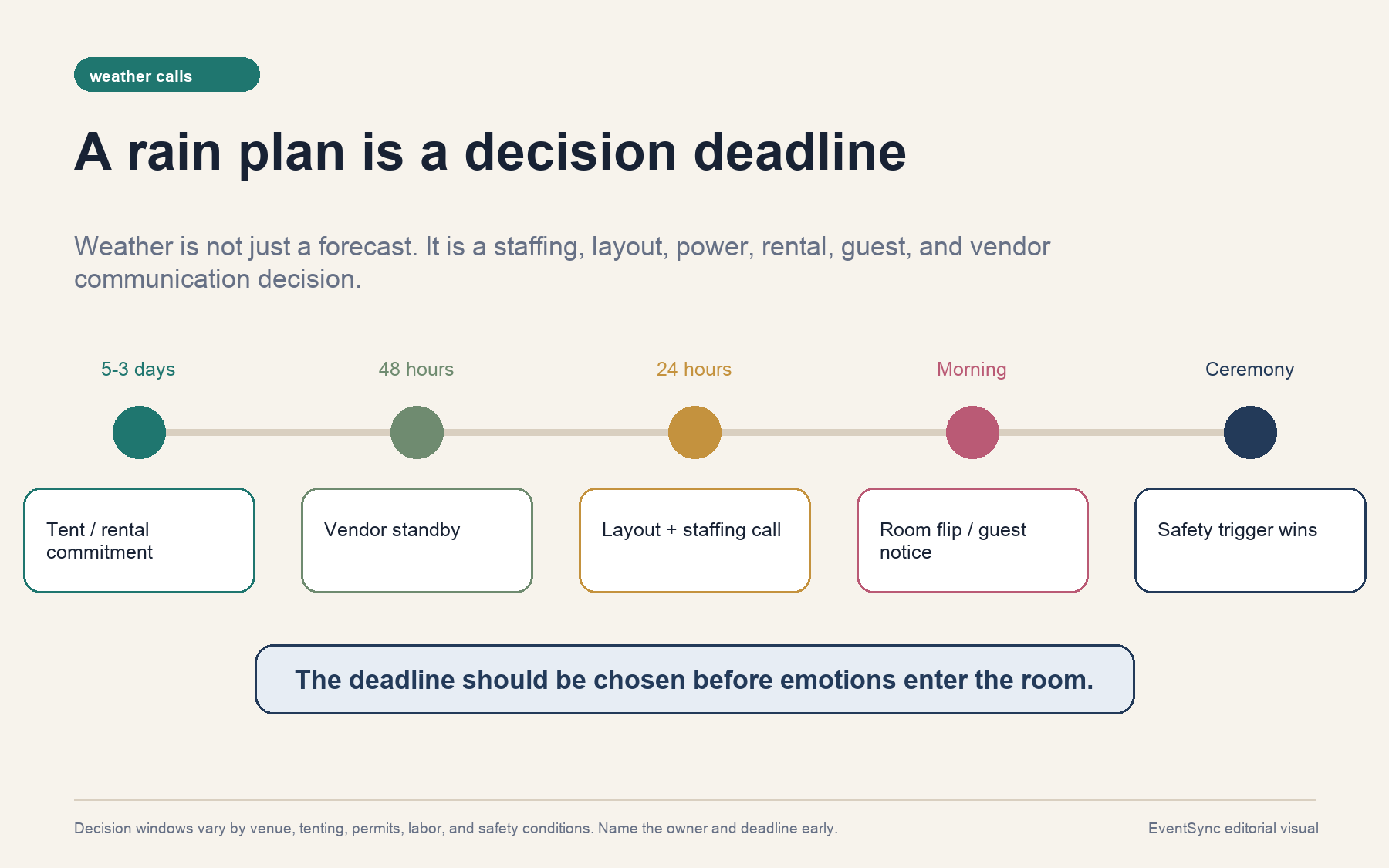
The best weather plans remove as much emotion as possible from the decision point. They name the owner, define the deadline, identify what information will be used, and list who gets notified if the plan changes. Waiting can feel hopeful. But if waiting means vendors no longer have enough time to execute the safer plan, waiting is not neutral. It is a decision too.
Reception pacing is also recovery
Couples tend to think of the reception timeline as the fun part: entrances, first dance, dinner, speeches, parent dances, cake, open dancing, send-off. Vendors tend to see a sequence of energy and service dependencies.
Dinner cannot always move casually because kitchen timing is built around service windows. Vendor meals should be timed so working vendors can eat and return before speeches, dances, golden-hour pulls, or cake cutting. Toasts affect the DJ, the catering team, the photographer, the videographer, and the room energy. Cake cutting can be a cue for older guests to leave or for late-night service to begin. Open dancing needs enough uninterrupted time to become a party rather than a series of false starts.
A recovery-minded reception timeline groups formalities intentionally. It avoids repeatedly stopping and restarting the room. It keeps the catering captain and DJ aligned. It gives the photographer and videographer clear notice before major moments. It protects the couple from finding out too late that the venue has started teardown while personal items are still scattered around the room.
How to build a timeline that recovers
The goal is not to make the day complicated. The goal is to make the hidden work visible early enough that someone can own it.
Mark ceremony time, sunset, venue access, hard stop, transportation deadlines, catering service, and weather calls before filling the rest of the day.
For each block, ask what must happen before it can start. Any block with many dependencies needs extra protection upstream.
The morning and transition blocks need real cushion. Late-day buffer often disappears before the team ever reaches it.
Name the flexible blocks in advance: cocktail-hour length, optional portraits, some reception formalities, open-dance length, and nonessential traditions.
Every live decision needs a person. The couple should not be the person routing vendor questions once the day starts.
Decide how changes are broadcast and confirmed: radio, text, live timeline, vendor huddle, or another clear channel.
The final timeline audit
Before the timeline goes out, read it once like something will go wrong. Then confirm these answers are visible:
- Who has authority to change the live timeline?
- Which moments are protected even if the day runs late?
- Where does the first 20-minute delay get absorbed?
- Which vendors need to be told immediately if ceremony, portraits, dinner, or weather plans shift?
- Who takes home gifts, cards, personal items, extra decor, and paperwork?
- Which version should each group use: master, vendor, family, wedding party, or guest-facing?
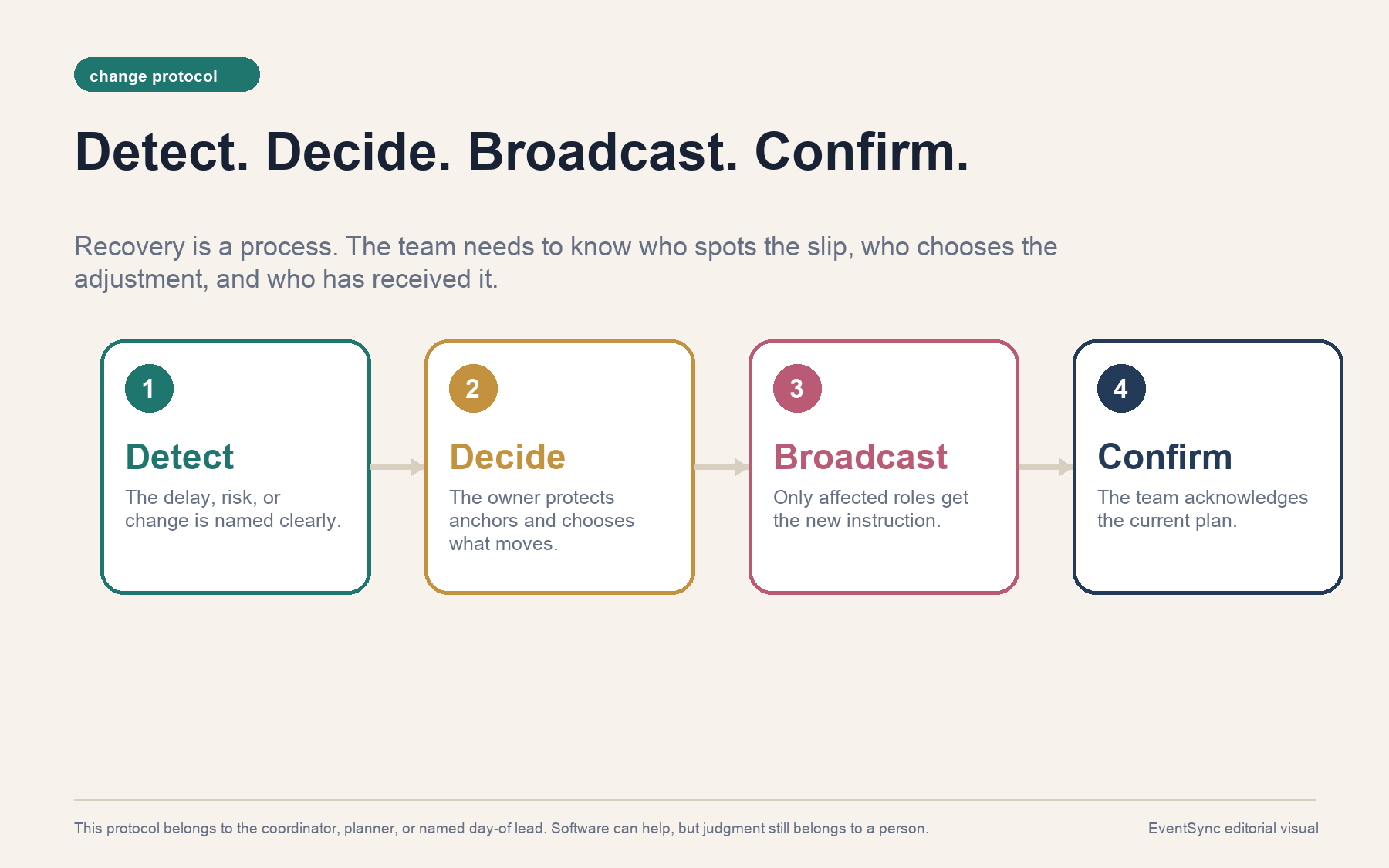
The protect, move, notify test
Before finalizing any timeline block, ask three questions:
- Protect: Is this block fixed, semi-fixed, or flexible?
- Move: If this slips by 15 or 20 minutes, what moves with it?
- Notify: Who needs to know within five minutes?
If nobody can answer those questions, the block is not fully planned. It is only scheduled.
A note on modern coordination tools
Planning platforms like Zola, The Knot, and Joy are helpful for the planning universe around the wedding: guest lists, websites, registry, planning checklists, and broad organization. Professional tools like Aisle Planner and Timeline Genius show how planners and coordinators think about the operational layer: filtered timelines, shared versions, exports, collaboration, and role-specific information.
EventSync is built around the same day-of principle: one live timeline, role-aware updates, vendor check-ins, and a coordinator or named lead still in control. The point is not to replace human judgment. The point is to stop asking one person to run a live event from a document that cannot tell everyone what changed.
If you are building your timeline now, start with the wedding day timeline template. If you already have the plan and need the live execution layer, see the wedding timeline app or the day-of coordinator app.
The practical takeaway
A wedding timeline should not make promises the day cannot keep. It should give the team a way to protect what matters, absorb what changes, and keep the couple out of the routing role.
When the day moves, the question is not whether the timeline was wrong. The question is whether the timeline was built to recover.
Questions couples and teams ask
How detailed should a wedding timeline be?
Detailed enough that no vendor, family member, or wedding-party member has to guess where to be for their part. The master version should include vendor arrivals, setup, cues, transitions, meals, formalities, weather decisions, and load-out. Shared versions should be filtered by role.
Who should own timeline changes on the wedding day?
A planner, day-of coordinator, venue lead, or clearly assigned point person should own live changes. The couple should not be the routing node once the day starts.
Is a printed timeline still useful?
Yes. A printout is useful for pre-day alignment and as a backup reference. It should not be treated as the live source of truth after delays, weather calls, or vendor timing changes begin.
What is the biggest timeline mistake?
Treating each block as separate. A wedding is a dependency chain. If the morning slips, photos, transportation, ceremony readiness, catering, reception flow, and load-out can all feel it.
Sources and notes
This guide synthesizes mainstream wedding planning guidance, professional workflow sources, and vendor operations patterns. Specific timing should always be confirmed with your actual venue and vendor team.
- Zola: How to Plan a Wedding for broad planning phases, day-of timeline sharing, and planning-tool context.
- The Knot: Wedding Timeline and Template for sample timeline structure, vendor load-in, buffer guidance, and distribution advice.
- The Knot: Wedding Hair and Makeup Timeline for beauty timing ranges and morning planning considerations.
- Brides: Wedding Photography Timeline for photo sequence, shot-list planning, and keeping the photo team aligned.
- The Knot: Outdoor Wedding Backup Plan for rain-plan planning, tent considerations, and making the weather call with the vendor team.
- Brides: How to Create a Backup Plan for Your Wedding for backup-plan scope, layout, lighting, guest movement, and vendor coordination.
- The Knot: Wedding Vendor Meals for vendor-meal planning and contract considerations.
- The Knot: Wedding Transportation Tips for transportation planning and guest movement considerations.
- Aisle Planner: Downloading the Timeline for filtered timeline exports and vendor, client, or wedding-party distribution workflows.
- Timeline Genius for professional timeline workflow context, including collaboration and tailored timeline views.