Wedding Day Assistant is not a chatbot. It is an operational assistant for the actual wedding day.
The name matters. A wedding day does not need another chat window. It needs a calm system that knows the timeline, the roles, the risks, and what the planner must approve next.
When people hear "assistant," they often picture a chatbot. That is not what EventSync Wedding Day Assistant is built to be.
A chatbot answers questions. Wedding Day Assistant sits inside the wedding-day operating flow. It looks at the plan, the timeline, role responsibilities, arrival status, and day-of changes, then surfaces useful next steps to the planner or team lead.
What a planning app does
A planning app helps you get ready. It can organize budgets, guests, vendors, checklist tasks, and timeline drafts. That work is important because the wedding day cannot run well without a plan.
But once the day starts, the user need changes. The planner is not asking, "What should I plan someday?" The planner is asking, "What is happening right now, what is drifting, who needs the next cue, and what should I approve?"
What Wedding Day Assistant does
Planning readiness
Surfaces missing setup that matters for the day: vendor arrivals, meal readiness, ceremony backup, transportation, and timeline gaps.
Day-of risk flags
Highlights current-state problems such as late vendors, tight timing, missing handoffs, or blocks that need planner attention.
Role-specific handoffs
Shows each role what matters to them: the caterer's service board, the photographer's shot board, the DJ's cue deck, the venue's operations board.
SmartRipple recovery
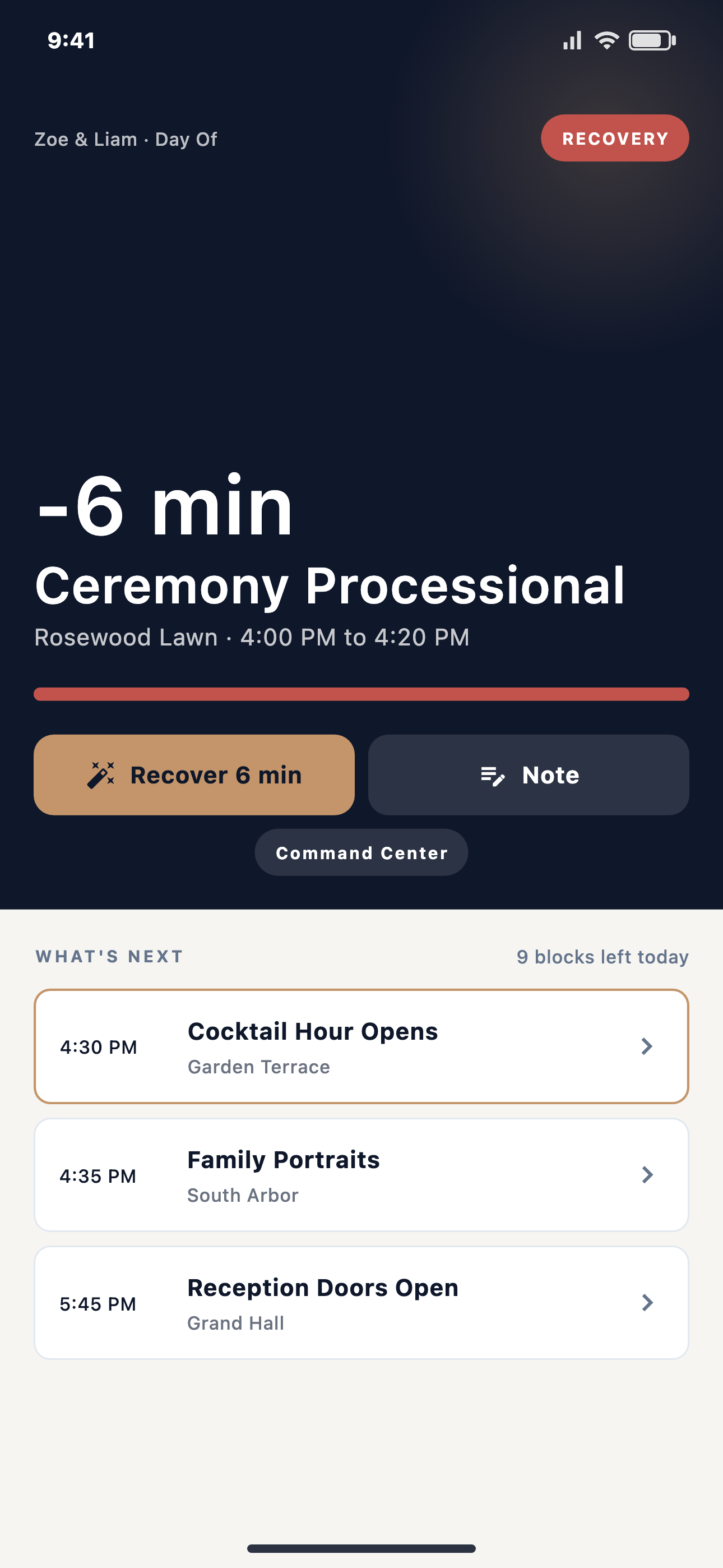
Suggests how to protect fixed moments and recover time from buffers or compressible blocks, then waits for planner approval.
SmartRipple is a good example
Imagine the ceremony runs 12 minutes late. A generic app might only show that the timeline is off. A spreadsheet will simply be wrong until someone manually updates it.
SmartRipple can suggest a recovery path: protect the ceremony, keep the first dance fixed, borrow a few minutes from a transition buffer, compress a flexible block, and show what changes for the DJ, caterer, photographer, and venue.
That suggestion is not the same as an automatic decision. The planner still decides whether the recovery is right for that room, that couple, and that moment.
The day drifts
Ceremony runs 12 minutes late and dinner timing is at risk.
Wedding Day Assistant explains the recovery
SmartRipple shows suggested trims, protected moments, affected roles, and unresolved timing if any remains.
The planner approves
Only after confirmation do affected role views update with the new timing and instructions.
Why role-specific handoffs matter
A wedding day is not one dashboard for everyone. A caterer needs meal counts, service timing, dietary aggregates, and table-by-table cues. A photographer needs the current photo moment, next photo moment, family groups, must-have shots, timing, and location notes. A DJ/MC needs cue order, entrances, announcements, speeches, dances, and reception sequence.
The couple does not need any of that operational noise. They need a calm journey: where to be, what is next, and the moments that matter.
What EventSync deliberately avoids
- No unsupervised timeline decisions.
- No external SMS or email promises from Wedding Day Assistant.
- No planner authority given to vendors or guests.
- No claim that software physically replaces an on-site coordinator.
- No chatbot-first positioning when the product value is operational.
The practical takeaway
If a couple is still planning, they need planning tools. If a planner is running the actual day, they need Day-Of Command and Wedding Day Assistant. EventSync connects those two moments so the plan does not fall apart at the exact point it matters most.
Try the wedding-day flow
Open the product demo to see SmartRipple, role handoffs, vendor check-ins, and planner approval in a fake wedding.
Open the product demo