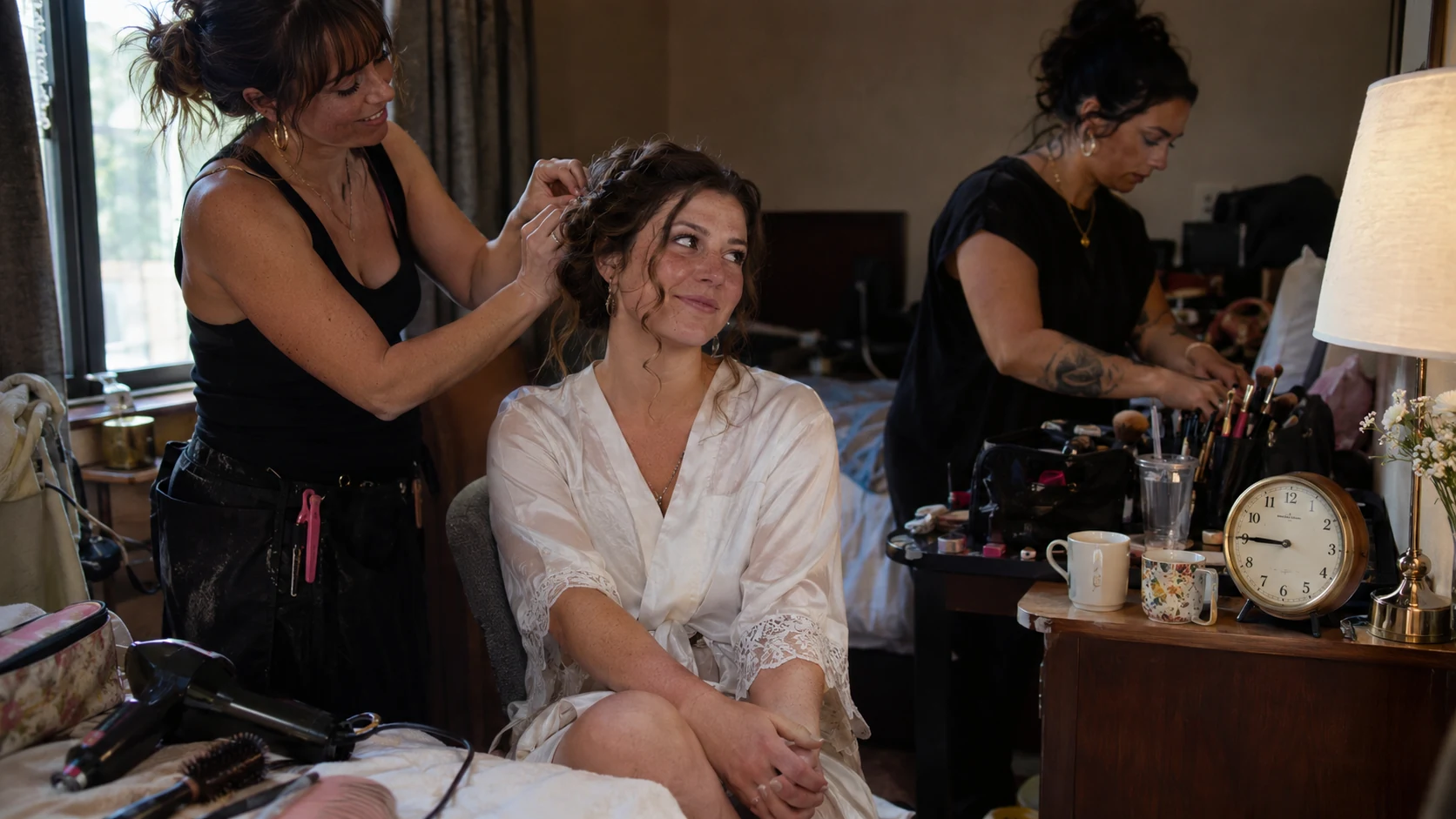
The ceremony may be at 4:00, but your hair and makeup deadline could be much earlier. You may need time to get dressed, travel, take photographs, greet family or prepare for another meaningful part of the day.
When the beauty schedule slips, those are often the moments that feel the pressure first. A little preparation can make the morning easier to manage, and a clear recovery plan can help everyone make decisions if something still goes wrong.
Here are the problems to plan for, questions to ask your beauty team, and practical steps to take if the schedule falls behind.
Start with the moment you need to be ready
Before deciding when hair and makeup should start, ask your photographer, planner and beauty team when each person needs to be finished. That may be the time you need to get dressed, travel, take portraits, include family in a tea ceremony or another event, or have someone ready to help you dress.
Then work backward, including time for final touch-ups, moving between locations and a buffer for things that take longer than expected. For example, if portraits begin at 1:30 p.m., the beauty team might agree on a 1:00 p.m. finish so there is time to dress and reach the photo location. That is only an example: an elaborate outfit or a longer journey may need more time. Makeup and hair artist Paige Anderson recommends setting the photo-ready deadline first. [1]
Ask your team: “What time does each of us need to be fully ready, and how much time should we allow between the last beauty service and that moment?”
Problem 1 The artist arrives late or cannot make it
Traffic, illness, an emergency or a scheduling mistake can disrupt an arrival. Even a confirmed plan deserves a backup conversation.
How to prepare
Before the wedding, confirm the arrival time, address, room, parking instructions and the name and phone number of the person running the morning. Ask the beauty company what happens if an artist is ill or delayed, whether they have a replacement network, and who will contact you or your coordinator. Read the agreement so you understand the provider’s cancellation and replacement terms. Some companies promise to try to find a replacement, but that is different from guaranteeing one will be available. [2]
If it happens
Have the coordinator or another trusted person call the artist and, if applicable, the company. Ask for a realistic arrival estimate and whether another artist can be sent. At the same time, tell the photographer and anyone responsible for the next fixed event what is happening. If the wait threatens an important deadline, discuss a simpler look, a trusted person helping, or doing your own hair or makeup. Choose the option that feels right to you and is feasible in the time available.
One bridesmaid described calling around when hair and makeup providers cancelled on the morning of a wedding. Two hairdressers came to help, although their available makeup supplies were not an ideal match. It is one person’s experience, but it shows why a backup plan should include contacts and a realistic alternative if a replacement cannot provide every service. [3]
Problem 2 Someone misses their appointment
A schedule can be carefully planned and still stall if the next person is not there. An artist may be ready to work while someone is getting breakfast, traveling from another room or assuming they can arrive at any point during “getting ready.” In one bride’s account, late arrivals contributed to the group falling behind, and planned pre-ceremony photos had to happen afterward. [4]
How to prepare
Give each person their own arrival time, service time and location. Share the preparation instructions from the beauty team too. For example, some styles require clean, dry hair, but follow your stylist’s directions for the specific service. Ask someone who is already on site to take an early appointment, if that works for the artists. Make sure the person helping you dress is finished when they are needed.
If it happens
Tell the artist as soon as you know someone is missing. Ask whether another ready person can take that slot and whether the late person can be fitted in later. That swap may not always be possible. Styles take different amounts of time, the person may be needed elsewhere, and the artist may have another commitment. Your agreement may also include late or overtime fees. Let the artist confirm what works instead of promising a missed service can be made up. [5]
Problem 3 There are more services than the schedule can hold
Counting people is a start, but it does not tell the whole story. If four people each want hair and makeup, that is eight services. Extensions, a detailed style, extra touch-ups or a person who needs both services by an earlier deadline may change the timing. Two separate artists can work at the same time, but one person cannot sit in both chairs at once. A workable rotation matters just as much as the total number of minutes. [1]
How to prepare
Give your beauty team a list of everyone receiving a service, whether they need hair, makeup or both, any extensions or accessories, when each person needs to be ready, and who is needed for early photos or to help with dressing. Ask the artists to build or approve one shared schedule. Confirm the number of artists, their setup needs, the space available and any cost for additional help.
There is no universal rule that the couple must go first, last or second-to-last. The right order depends on the artists’ process, the services, the people needed for photographs and how much room the schedule has. Agree on it together.
If it happens
If the schedule is already slipping, ask the lead artist how much time remains and what can realistically be completed. Then decide together whether to change the order, simplify a style, move an optional service or adjust a later activity. Avoid quietly shortening every appointment on paper. The artists need enough time to do the work, and the couple deserves to know what is being changed.
Problem 4 Someone asks for an extra service on the day
A friend or family member may decide they would love to have their hair or makeup done after seeing everyone else. It is understandable, but an unplanned service needs both an available artist and an actual opening in the schedule.
How to prepare
Confirm the service list before the wedding and ask the beauty team how late changes are handled. If there is a buffer, discuss whether it is protected for delays rather than available for an extra appointment.
If it happens
Ask the artist before saying yes. If there is time and they agree, confirm the cost and whether adding the service affects anyone else’s finish time. If there is no room, it is okay to keep the original plan.
Problem 5 The room or travel plan slows down setup
A beauty team’s work starts before the first person sits down. They may need to bring in equipment, set up products and lighting, find outlets and prepare hot tools. A room that opens later than expected or a move between locations can use up time that was meant for services. Brite Beauty notes that changing getting-ready locations involves packing equipment, traveling, setting up again and reheating tools. [6]
How to prepare
Confirm when the room opens, where the artists should park, how they enter, and whether there is enough space, light and power for each station. Include setup and travel in the schedule, using estimates from the people doing the work. If you plan to move locations, ask the team how long the move will take and whether there is a relocation fee. Do not assume the artists can begin work immediately upon arrival.
If it happens
Tell the venue contact and beauty lead what is blocking setup. Ask whether there is a suitable nearby room or an alternative way to get the equipment inside. If the start time changes, tell the photographer and coordinator early enough to discuss the next deadline. A different room only helps if it meets the artists’ needs and the venue can make it available.
If the schedule is behind decide what matters most
When you realize the morning is running late, you do not have to solve the entire day at once. Start with the next deadline.
- Find out where things stand. Ask the beauty lead who is finished, what remains and their best estimate for completion.
- Check the next fixed commitment. Is it a ceremony, transport departure, family event or another appointment? Confirm with the people responsible rather than guessing.
- Ask the couple what they want to protect. That might be a first look, time with family, a particular photograph or a calm moment before the ceremony.
- Choose the tradeoffs with the affected professionals. The photographer might suggest fewer group combinations, portraits in a nearby location, or moving some photos after the ceremony. A change may affect guests, travel, lighting or another vendor, so confirm it before treating it as the new plan.
- Tell the people who need the update. Share the new time, place and any changed responsibilities. Ask for confirmation when the next step depends on someone seeing the message.
In one photographer’s account, hair and makeup ran 90 minutes behind. The couple kept the first look, shortened nearby portraits, reduced wedding-party photos and moved family photos after the ceremony. That was a workable choice for that wedding, not a promise that the same moments can be moved at every event. [7]
A delay can also affect more than photographs. In a public account of her 2022 wedding, a bride described her makeup artist arriving late before both the morning celebrations and an evening tea ceremony, leaving relatives waiting while family members finished getting ready. The lesson is to identify the people and moments that have their own deadlines, then include them in the plan. [8]
Where a shared timeline can help
Whether you use a printed schedule, a shared document or an app, the goal is the same: the people helping should know the current plan and who makes decisions when it changes.
In EventSync, a team lead can keep times, locations and instructions with timeline blocks and track expected vendor arrivals. If the day slips, SmartRipple can show a recovery preview for a person to review before applying a change. Role views and targeted updates can help communicate an agreed plan to the people affected. [9]
The app cannot make an artist arrive, find a replacement or decide which moment matters most to you. A planner, coordinator or trusted lead still needs to make calls and confirm the tradeoffs. If someone is offline, new team updates require a connection, so keep an agreed backup way to reach them.
A quick checklist for your beauty team
Before the wedding, confirm:
- The finish time for each person and the next event they need to attend.
- Each person’s hair and makeup services, including extensions or accessories.
- The order of appointments and when each person should arrive.
- Artist arrival, setup, room access, parking, light and power.
- Any travel or move between getting-ready locations.
- Time for touch-ups, dressing and a buffer.
- Who to call if someone is late or an artist cannot attend.
- The policy for extra services, overtime, cancellation and replacements.
- Who can make changes on the day and how the photographer and other affected people will hear about them.
A thoughtful schedule gives everyone a starting point. A backup plan gives your team a way to respond when the morning does not go exactly as planned.
Sources and context
The public accounts below are individual recollections and illustrate possible problems, not their prevalence. Vendor policies are examples, not universal terms. EventSync feature statements are based on its published information, not an independent test of this specific workflow.
[1] Paige Anderson Wedding hair and makeup timeline
[2] Wedding Hair and Makeup by Lauren Terms and conditions
[3] Bridesmaid’s account of a wedding morning cancellation Reddit 2023
[4] Bride’s account of late wedding party arrivals Reddit 2022
[5] Jessica Hair and Makeup Artistry Questions and answers
[6] Brite Beauty Timing questions
[7] Heck Designs and Photography Wedding timeline case